How to Choose the Right Working Area for a Large Format Laser Marking Machine
2026-09-28 16:07:05
www.hiteccnc.com
What Does “Working Area” Mean on a Laser Marking Machine?
The working area is the usable processing field in which the laser system can mark or engrave the workpiece.
For a conventional galvo laser marker, the marking field is primarily determined by the selected F-theta lens and optical system.
This works extremely well for relatively small parts.
However, when the workpiece becomes significantly larger than the optical field, simply installing a larger lens is not always the best solution. Optical performance, spot size, energy distribution and marking quality must also be considered.
This is where a large format laser marking system becomes different.
Instead of relying only on a large optical field, the laser head or optical system can work together with a mechanical positioning system to extend the practical processing area.
The result is a system designed around large workpieces rather than simply a larger galvo lens.
How Large Should Your Laser Marking Area Be?
The first question should not be: “What is the largest machine you sell?”
It should be:
“What is the largest workpiece I need to process?”
A practical starting point is to identify: • Largest workpiece dimensions • Smallest workpiece dimensions • Required marking area • Material and surface condition • Number of parts processed per cycle • Required marking depth • Required positioning accuracy • Whether the workpiece can be repositioned • Expected production volume
For example, a manufacturer processing small aluminum nameplates may benefit more from a compact system with an efficient layout than from a very large machine.
In contrast, manufacturers working with elevator panels, large stainless-steel sheets, industrial signs or oversized metal plates may need a substantially larger working area.
Oversized sheets, panels and large industrial workpieces
These dimensions should be treated as starting points for machine configuration rather than a universal recommendation.
The correct size depends on the actual production process.
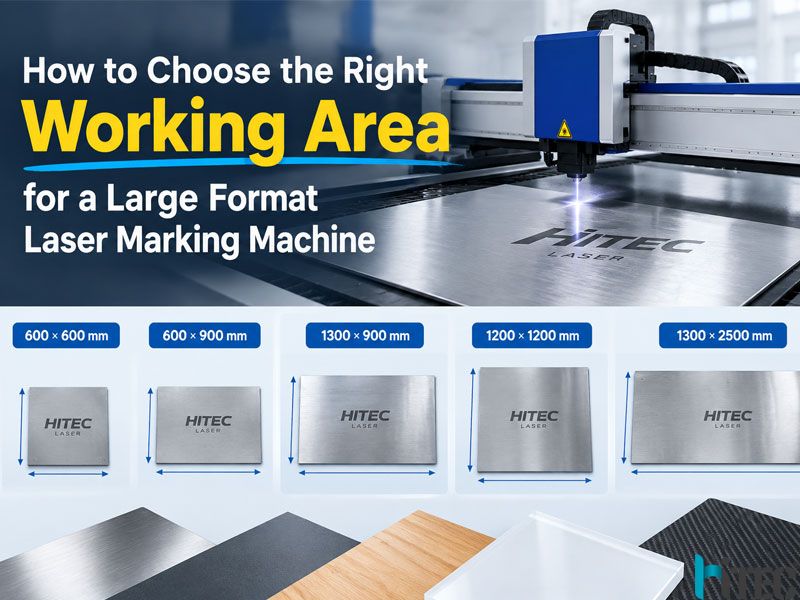
600 × 600 mm: When a Medium Working Area Is Enough
A 600 × 600 mm system can be suitable when the workpieces are medium-sized or when multiple smaller components need to be processed within one setup.
Typical applications may include: • Metal nameplates • Industrial labels • Aluminum plates • Stainless-steel components • Logos • Machine panels • Multiple small parts in one batch
One important advantage of a larger-than-standard marking area is that several smaller workpieces can potentially be arranged in the same production cycle.
Instead of processing one part, removing it, positioning another part and repeating the process, the operator can optimize the layout around the available working area.
For batch production, this can be more important than simply looking at the maximum size of one individual part.
600 × 900 mm: A Practical Choice for Larger Industrial Parts
A 600 × 900 mm working area provides additional room for larger plates and for arranging multiple components.
The approximate imperial equivalent is 24 × 36 inches, a size that is particularly relevant to customers working with industrial panels, signs and metal components.
Typical applications include:
• Large metal nameplates • Stainless-steel panels • Aluminum plates • Industrial signage • Machine identification plates • Multiple components in one setup
For manufacturers whose parts are larger than a conventional 300 × 300 mm or 400 × 400 mm galvo field, a 600 × 900 mm configuration can provide a practical increase in usable production space without immediately moving to an oversized system.
1300 × 900 mm: When the Workpiece Becomes the Main Challenge
When workpieces approach approximately 51 × 35 inches, the machine architecture becomes increasingly important.
At this scale, the question is no longer simply:
“Can the lens cover this area?”
Instead, manufacturers should consider how the laser system physically reaches different positions on the workpiece.
Applications may include: • Large industrial panels • Elevator-related components • Decorative metal panels • Large signs • Stainless-steel sheets • Aluminum sheets • Large equipment panels
For these applications, a gantry-moving or hybrid galvo + gantry system can provide a fundamentally different approach from a conventional fixed galvo marker.
The galvo system performs the high-speed laser scanning, while the mechanical positioning system extends the usable processing area.
1200 × 1200 mm: Large Area Without Going to a Full Sheet
A 1200 × 1200 mm system provides approximately 47 × 47 inches of working space.
This configuration can be useful when customers need substantially more room than a standard industrial marking field but do not necessarily need a full 4 × 8 ft sheet-processing platform.
The key is to match the machine to the actual workpiece.
Buying a machine that is significantly larger than necessary can increase:
A larger machine is not automatically a better machine.
The objective should be the right working area for the production process.
1300 × 2500 mm: For Oversized Panels and Large Sheets
For applications involving very large workpieces, a working area of 1300 × 2500 mm, approximately 51 × 98 inches, provides a substantially larger processing platform.
This type of configuration can be considered for: • Large stainless-steel sheets • Large aluminum sheets • Industrial panels • Decorative panels • Large signage • Oversized metal components
At this scale, the mechanical structure, positioning system, optical configuration and calibration become just as important as laser power.
A large working area is only useful when the machine can maintain stable and repeatable processing performance across the intended area.
Does a Larger Working Area Reduce Laser Marking Accuracy?
Not necessarily.
A common misconception is: “The larger the machine, the lower the marking accuracy.”
The actual result depends on the complete system design.
This is one of the most important decisions when selecting a large format laser marking machine.
Conventional Galvo System
A conventional galvo marker uses mirrors to rapidly move the laser beam across a defined optical field.
Its advantages include: • High marking speed • Compact design • Excellent performance for smaller workpieces • Efficient processing of logos, text and serial numbers
However, the optical field is limited by the lens and optical configuration.
Large Working Area Does Not Mean “Infinite” Marking
Another important point is to understand what “large format” actually means.
A large format laser marking machine can provide a much larger practical processing area, but this does not mean that a laser can create an unlimited single optical field.
For very large workpieces, the system may need controlled mechanical movement and coordinated positioning.
The engineering objective is to maintain: • Accurate positioning • Consistent marking quality • Reliable alignment • Stable mechanical movement • Repeatable production results
This distinction is important when comparing large format laser systems from different manufacturers.
Always ask how the machine achieves the stated working area, rather than looking only at the number in the specification sheet.
What Information Should You Send Before Requesting a Quote?
A professional laser manufacturer should not recommend a machine based only on a requested wattage.
Before choosing the machine, provide the following information:
1. Largest Workpiece Size
For example:
1200 × 2400 mm
rather than simply saying:
“I need a large machine.”
2. Typical Workpiece Size
Your most common production size is often more important than the absolute maximum.
3. Material
For example:
- Stainless steel
- Aluminum
- Carbon steel
- Brass
- Copper
- Plastic
- Coated metal
4. Required Marking Area
Tell the manufacturer how large the actual graphic or marking needs to be.
5. Marking Requirement
Do you need:
Surface marking?
Deep engraving?
Black marking?
High-speed text?
QR codes?
Serial numbers?
Large graphics?
Logos?
6. Production Volume
A machine for occasional prototype work may have very different requirements from a machine running continuously in production.
7. Repositioning Requirements
Ask yourself:
Can the workpiece be moved manually during processing?
If repositioning is acceptable, a smaller system may sometimes be sufficient.
If the workpiece must remain in the same position throughout the process, a larger working area may be justified.
The Right Machine Is Not Always the Largest Machine
Large format laser marking is not simply about making the machine bigger.
A properly selected system should balance:
Workpiece Size + Marking Area + Production Layout + Optical System + Mechanical Structure + Accuracy + Production Efficiency
For some customers, 600 × 600 mm is sufficient.
For others, 600 × 900 mm or 1300 × 900 mm provides a better production layout.
For large industrial panels and sheet materials, 1200 × 1200 mm or 1300 × 2500 mm may be more appropriate.
The key is to start with the workpiece—not the machine model.
How HITEC Laser Configures Large Format Laser Marking Systems
At HITEC Laser, large format laser marking systems are configured according to the customer's actual application rather than using one standard configuration for every project.
Depending on the application, the system can be configured around: • Different working areas • Fiber, UV or CO₂ laser sources • Different laser powers • Galvo scanning systems • Gantry-moving systems
VHybrid galvo + gantry architectures • Positioning and calibration requirements • Custom machine dimensions
The purpose is not simply to offer the largest possible marking area.
It is to build a system that provides the required working space while maintaining appropriate mechanical stability, optical performance and production efficiency.
Frequently Asked Questions
What is the largest working area for a laser marking machine?
There is no universal maximum size. Large format laser marking systems can be engineered for substantially larger workpieces than conventional galvo markers, depending on the mechanical and optical architecture.
Is 600 × 900 mm enough for industrial laser marking?
It can be suitable for many industrial plates, panels, nameplates and multiple-part layouts. The correct size depends on the customer's largest and most common workpieces.
What size laser marking machine do I need for a 4 × 8 ft sheet?
A 4 × 8 ft sheet is approximately 1220 × 2440 mm. The required machine configuration depends on whether the entire sheet must remain in one position and how the laser system is designed to cover the working area.
Does a larger laser marking area reduce accuracy?
Not inherently. Accuracy depends on the complete optical, mechanical, motion-control and calibration system.
Is a larger laser marking machine always better?
No. An oversized machine can increase cost, footprint and mechanical requirements without providing a meaningful production benefit if your workpieces are relatively small.
Should I choose a 6090 or 1390 laser marking machine?
The decision should be based on the actual workpiece dimensions, required marking area and production layout rather than the model number alone.
Can one large format laser marking machine process different sizes of workpieces?
Yes. A properly configured large format system can process different workpiece sizes within its usable working area. The exact configuration should be selected according to the customer's applications.
Final Takeaway
Choose the working area around your production—not around the machine catalog.
If your largest workpiece is 600 × 600 mm, there may be little reason to purchase a 1300 × 2500 mm system.
If you regularly process large industrial panels or sheets, however, a conventional small-field galvo marker may create unnecessary repositioning and handling work.
Before purchasing a large format laser marking machine, provide your laser manufacturer with your largest workpiece dimensions, typical workpiece size, material, marking requirements and production volume.
With this information, the machine architecture, working area, laser source and power can be selected around the real application.
Need help choosing the right working area? Send HITEC Laser your largest workpiece dimensions and a sample photo or drawing. We can recommend a suitable large format laser marking configuration based on your application.