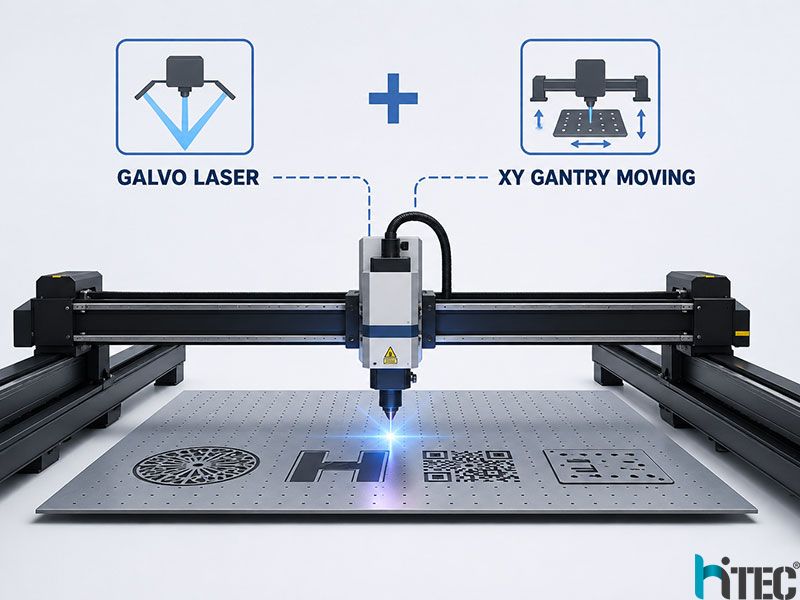
When laser marking moves beyond a small standard field, manufacturers face a fundamental choice: increase the optical scanning field with a longer focal-length lens, or physically move the laser head across the workpiece.
For industrial applications requiring both high-speed marking and large-format processing, there is a third and often more practical solution:
Combine a high-speed GALVO laser scanner with an XY gantry moving module.
This hybrid architecture combines the speed of optical scanning with the working range of mechanical motion, making it particularly suitable for large metal sheets, industrial signs, elevator panels, nameplates, logos, oversized components, and high-volume batch marking.
A GALVO laser system uses high-speed galvanometer mirrors to steer the laser beam across a defined marking field. Because only lightweight mirrors move, the system can change beam direction extremely quickly, making GALVO technology highly effective for fine details, text, logos, QR codes, patterns, and high-speed engraving.
An XY gantry system, in contrast, uses mechanical motion along the X and Y axes to position the laser head over a much larger working area.
The hybrid system combines both:
GALVO = high-speed local scanning
XY Gantry = large-area positioning
Instead of asking one motion system to do everything, each system performs the task it is best suited for.
How Does the GALVO + XY System Work?
The basic processing sequence is simple.
The XY gantry moves the GALVO head to the required processing position.
The GALVO scanner rapidly marks the pattern within its optical field.
The XY system moves to the next position.
The GALVO performs the next high-speed marking operation.
The controller coordinates the two motion systems according to the processing file.
In advanced systems, the GALVO scanner and XY motion platform can be synchronised through a dedicated motion controller, allowing the optical scanner and mechanical axes to work as one coordinated processing system. Industrial four-axis systems, for example, combine XY galvanometers with XY motion stages for large-field laser processing.
This architecture is sometimes described as a hybrid GALVO-gantry laser, travelling GALVO laser, or GALVO + XY motion system.
1. High GALVO Speed Without Giving Up a Large Working Area
This is the biggest advantage.
A conventional XY gantry laser must physically move the laser head to draw every part of the design.
That means the mechanical system is responsible for both:
positioning
marking movement
Mechanical motion has mass, acceleration and deceleration. As the marking path becomes more detailed, these movements can limit productivity.
GALVO works differently.
The mirrors change the direction of the laser beam instead of physically moving the entire laser head. This gives GALVO systems their characteristic high scanning speed.
With a hybrid system:
XY Gantry handles large movement.
GALVO handles fast marking.
The result is a much more efficient division of motion.
2. Large Format Without Using an Extremely Large F-Theta Lens
A conventional GALVO marking machine is limited by its optical field.
For example, depending on the optical configuration, a standard marking system may operate within fields such as:
100 × 100 mm
150 × 150 mm
200 × 200 mm
300 × 300 mm
Increasing the field size generally requires longer focal-length optics, and larger fields can introduce compromises in spot size, focus uniformity and optical performance.
This creates a problem when the customer needs to process a:
600 × 600 mm
600 × 900 mm
1200 × 1200 mm
or even
1300 × 2500 mm workpiece.
Instead of forcing one lens to cover the entire area, the XY gantry physically moves the GALVO head.
The GALVO only needs to process the area within its optical field.
The gantry then moves the system to the next processing position.
This makes it possible to combine a relatively compact high-speed optical field with a much larger mechanical working area.
3. Better Efficiency for Large Sheets Covered With Multiple Designs
Consider a large stainless-steel sheet containing hundreds of individual logos, serial numbers, symbols or decorative patterns.
A conventional small-field GALVO machine cannot process the entire sheet without repositioning.
A traditional gantry marking system can cover the sheet, but the laser head must mechanically travel throughout the design.
The hybrid system takes a different approach.
The machine can: Move → GALVO mark → Move → GALVO mark → Move → GALVO mark
This is particularly useful when a large sheet contains many small or medium-sized individual graphics.
For example:
► Elevator panels
► Metal logos
► Nameplates
► Stainless-steel signs
► Decorative metal panels
► Electrical cabinets
► Industrial identification plates
► Automotive components
► Large batches of small parts
The gantry provides the large layout.
The GALVO provides the high-speed local processing.
4. Better Productivity for Repetitive Batch Marking
The hybrid architecture becomes particularly valuable when the customer is processing multiple parts on one large working table.
Instead of loading and unloading each part individually, multiple components can be placed across the working area.
The XY gantry moves between processing zones while the GALVO rapidly completes the marking pattern at each location.
This can reduce:
• manual repositioning
• fixture changes
• repeated loading and unloading
• idle time
• unnecessary mechanical travel
For factories processing large quantities of identical or different components, this can significantly improve workflow efficiency.
5. It Is More Flexible Than a Pure GALVO System
A standard GALVO machine is excellent when the marking area fits inside its optical field.
But once the customer's product becomes larger than the available lens field, the system needs another method of extending the working area.
An XY gantry provides that flexibility.
The customer can process: small parts → medium parts → large panels → oversized sheets
using the same basic GALVO scanning principle.
This is particularly valuable for industrial laser marking companies whose product sizes vary significantly from project to project.
6. It Is Faster Than Using a Moving Laser Head for Every Detail
A pure gantry system can provide a very large working area, but every line, letter and curve is generated through mechanical movement.
The GALVO system moves the beam optically instead.
Because the moving mass is extremely small, GALVO scanners can achieve very rapid beam positioning and scanning. Modern industrial scanners can reach several thousand mm/s depending on the scanner, laser source, optics and application.
This makes the hybrid architecture especially attractive when the design contains:
♦ dense text
♦ small characters
♦ QR codes
♦ barcodes
♦ fine lines
♦ logos
♦ detailed graphics
♦ repeated patterns
The gantry does not need to reproduce every tiny movement.
It only needs to position the GALVO head.
7. Better Use of High-Power Fiber Lasers
The combination becomes even more interesting when paired with high-power MOPA fiber lasers.
For applications such as:
♦ deep engraving
♦ black marking
♦ annealing
♦ surface engraving
♦ metal logo marking
♦ stainless-steel processing
♦ aluminum marking
♦ mold engraving
♦ industrial identification
the laser source can be selected according to the required processing depth, speed and material.
For example, a JPT MOPA fiber laser can be combined with a GALVO scanner for high-speed marking, while the XY gantry provides the large-format processing range.
This creates a scalable architecture rather than limiting the machine to one fixed marking field.
8. Large Format Does Not Have to Mean Slow
This is an important misconception in industrial laser processing.
Many buyers assume:
Large working area = slow machine
But the actual processing speed depends on how the machine moves the laser beam.
A large-format gantry machine using only mechanical movement may sacrifice speed.
A conventional GALVO machine provides speed but has a limited optical field.
The hybrid approach separates these two requirements:
Requirement
GALVO
XY Gantry
High-speed marking
Excellent
Moderate
Large working area
Limited by optics
Excellent
Fine details
Excellent
Good
Large metal sheets
Limited
Excellent
Positioning across large workpieces
Limited
Excellent
Repetitive batch marking
Excellent
Excellent
Large-format industrial applications
With XY
Excellent
The goal is not to make GALVO and gantry compete with each other.
The goal is to make them work together.
9. More Suitable for Industrial Automation
The GALVO + XY architecture also provides a strong foundation for automation.
The system can be integrated with:
► automatic loading and unloading
► conveyor systems
► vision positioning
► barcode or QR-code identification
► robotic loading
► production-line marking
► multi-part fixtures
► MES or factory data systems
The XY gantry controls where the laser works.
The GALVO controls how quickly the pattern is processed.
A suitable controller can coordinate the motion and laser processing sequence so that the entire system operates as one production platform.
This is why synchronised GALVO and XY motion is increasingly used in large-area laser processing applications.
10. When Should You Choose GALVO + XY Gantry?
The hybrid system is especially suitable when you have both large working areas and high-speed marking requirements.
Choose GALVO + XY Gantry when:
Your workpiece is larger than a standard GALVO field.
You need high-speed marking on large sheets.
One table contains many individual parts.
You need to mark hundreds or thousands of logos.
Your designs contain detailed graphics or small text.
You want to reduce manual repositioning.
You need flexible working areas.
You want to combine high-power fiber lasers with high-speed scanning.
You are planning future automation.
A standard GALVO may be enough when:
The entire design fits comfortably inside one optical field and the workpiece does not require large-area positioning.
A conventional XY gantry may be enough when:
The application is primarily large-format cutting, heavy engraving or processing where mechanical motion is more important than extremely high scanning speed.
GALVO + XY Gantry vs. Traditional Systems
The key difference is how the machine divides the work.
Traditional GALVO
Small/medium area + very high speed
Excellent for individual parts and compact marking fields.
Traditional XY Gantry
Large area + mechanical movement
Excellent for oversized workpieces but generally slower for fine, dense marking.
GALVO + XY Gantry
Large area + high-speed local scanning
This combines the two motion principles into one system.
The XY gantry provides the scale.
The GALVO provides the speed.
The laser provides the processing power.
The controller provides the synchronisation.
That combination is what makes the architecture particularly attractive for modern large-format industrial laser processing.
The Real Advantage: Use the Right Motion for the Right Job
The biggest mistake when designing a large-format laser system is trying to make one motion mechanism do everything.
A GALVO scanner is extremely good at rapidly moving a laser beam within its optical field.
A mechanical XY stage is extremely good at moving that processing field across a large workpiece.
Combining them creates a more balanced system:
Optical scanning for speed.
Mechanical movement for scale.
Laser power for processing capability.
Software and motion control for coordination.
For manufacturers processing large metal sheets, industrial panels, elevator plates, nameplates, logos and other oversized components, this hybrid architecture can provide a practical combination of speed, flexibility and large-format capability.
Final Takeaway
A GALVO + XY Gantry Moving Laser should not be viewed simply as a GALVO mounted on a moving platform.
It is a different machine architecture designed to solve a specific industrial problem:
How can you achieve the speed and detail of GALVO marking while processing workpieces much
larger than a conventional GALVO field?
The answer is to let each motion system do what it does best.
GALVO handles the high-speed marking.
XY Gantry handles the large-format movement.
When properly synchronized, the combination can transform a conventional laser marker into a flexible large-format industrial processing system—particularly for applications where large working areas, high throughput and detailed marking are required.