LED Mirror Factory Setup: Complete List of Equipment for Small Manufacturing Plants
2026-07-02 15:35:58
www.hiteccnc.com
How to Set Up a Small LED Mirror Factory (Complete Equipment Guide)
Setting up a small LED mirror manufacturing factory requires a combination of glass processing machines, precision finishing equipment, and LED assembly systems.
A complete production line ensures high-quality mirrors with accurate cutting, safe edges, stable lighting integration, and premium decorative finishing.
Below is a full breakdown of essential equipment needed for a modern LED mirror factory.
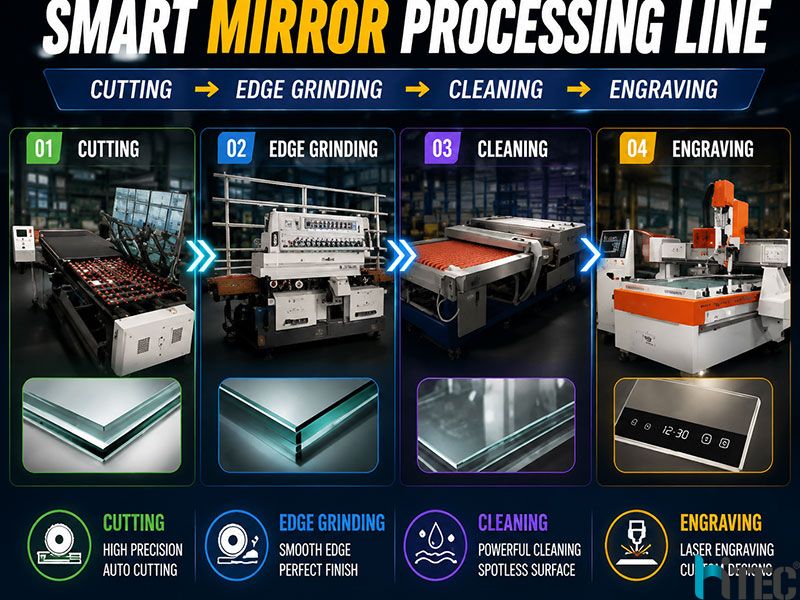
1. Glass Cutting Equipment (Basic Foundation of Production)
Glass cutting is the first step in LED mirror manufacturing.
Required Machines:
CNC glass cutting machine
Automatic glass cutting table
Manual cutting tools (for prototypes or small batches)
Function:
Cuts raw glass into required mirror shapes
Ensures size accuracy and reduces material waste
Prepares material for further processing
LED mirrors require precise holes for installation and wiring.
Applications:
LED strip installation
Touch switch mounting
Anti-fog system wiring
Wall mounting brackets
Benefits:
Prevents glass cracking
High precision positioning
Suitable for small to medium factories
4. Laser Processing System (Key Upgrade for High-End Mirrors)
Modern LED mirror factories increasingly rely on laser technology for advanced processing.
Laser Applications:
Mirror engraving (patterns, logos, decoration)
Frosting / sandblasting effect replacement
Large-area marking without stitching errors
Custom design processing on reflective surfaces
Why Laser is Important:
Non-contact processing (no tool wear)
High precision and repeatability
Clean edges and premium visual effect
Suitable for customized high-value mirrors
Laser systems significantly improve product value and brand differentiation.
Companies such as JINAN HITEC MACHINERY CO., LTD provide industrial laser solutions widely used in mirror engraving and marking production.
5. LED Assembly Workstation
This stage integrates lighting systems into the mirror.
Equipment Includes:
LED strip installation tables
Wiring and soldering stations
Power supply testing units
Light uniformity inspection tools
Function:
Ensures stable lighting performance
Improves product consistency
Reduces assembly errors
6. Anti-Fog System Installation Equipment
Many LED mirrors include anti-fog functionality for bathroom use.
Equipment:
Heating film laminating table
UV curing system
Coating spray system (optional)
Function:
Prevents mirror fogging
Improves user experience
Adds premium product value
7. Mirror Backing & Frame Assembly Line
Final assembly stage before packaging.
Components:
Aluminum or PVC frame assembly tools
Back panel sealing machines
Adhesive bonding systems
Function:
Ensures structural stability
Protects internal LED components
Completes final product assembly
8. Quality Control & Testing Equipment
Every LED mirror must pass strict inspection before shipment.
Testing Tools:
LED brightness testing meter
Electrical safety tester
Flatness inspection tools
Visual defect inspection station
Function:
Ensures product safety
Maintains consistent quality
Reduces after-sales issues
Conclusion: What Makes a Competitive LED Mirror Factory?
A small LED mirror factory can start with basic cutting and assembly machines, but to compete in the global market, automation and precision processing are essential.
Among all technologies, laser processing systems have become a key upgrade for modern manufacturers, enabling high-end engraving, branding, and decorative mirror production.
Advanced equipment suppliers like JINAN HITECRA MACHINERY CO., LTD support manufacturers in upgrading from basic production to high-value customized mirror manufacturing.
FAQ (Frequently Asked Questions)
Q1: What machines do I need to start a small LED mirror factory?
You need glass cutting machines, edge grinding machines, CNC drilling machines, LED assembly tools, and optional laser engraving systems for high-end products.
Q2: Can I start a LED mirror factory with low investment?
Yes. A basic setup only requires cutting, edging, and assembly equipment. Laser systems and automation can be added later as the business grows.
Q3: Why is laser technology used in mirror manufacturing?
Laser systems allow non-contact
engraving, precise marking, and decorative processing without damaging reflective surfaces.
Q4: What is the most important machine in a mirror factory?
The glass cutting machine and edge grinding machine are essential, while laser systems are critical for premium and customized products.
Q5: Is LED mirror manufacturing fully automated?
Small factories are usually semi-automated. Full automation is possible but requires higher investment in integrated production lines.