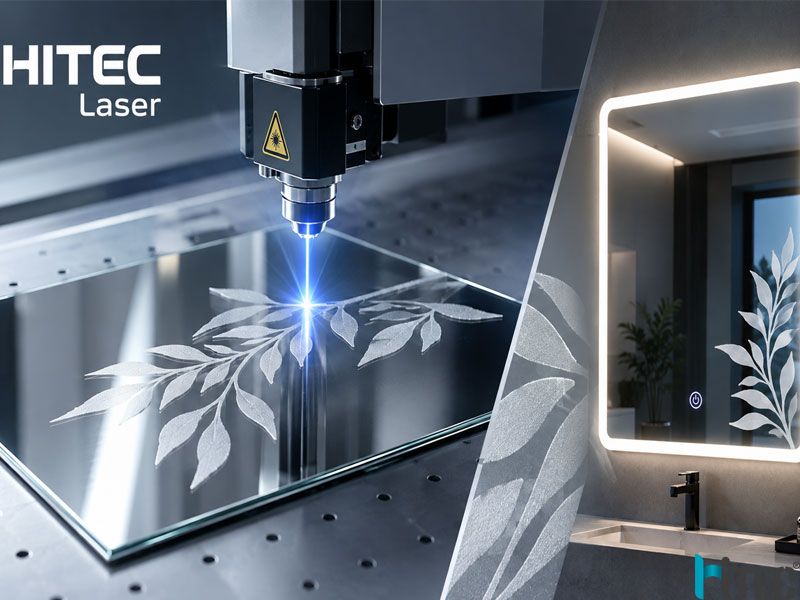
Mirror laser frosting is the process of creating a matte, translucent, or sandblasted-like visual effect on a selected area of mirror glass using controlled laser energy.
The processed area scatters light differently from the surrounding smooth glass, producing a visible frosted appearance.
Depending on the mirror construction and processing method, the finished effect can be used for: ♦ Decorative patterns ♦ Logos and branding ♦ Frosted borders ♦ Light-diffusing areas ♦ LED mirror designs ♦ Smart mirror interfaces ♦ Touch-control symbols ♦ Architectural glass decoration ♦ Custom names, graphics, and lettering
The important distinction is that a professional laser system should be selected according to the desired optical effect and the layer being processed, rather than simply the word “engraving.”
How Does Laser Frosting Create a Frosted Effect?
A conventional mirror has a highly smooth glass surface and a reflective structure behind the glass.
When a suitable laser process interacts with the target material, the processed area develops a different optical surface or coating condition.
Instead of behaving like the surrounding smooth mirror, the processed area scatters light.
This creates the characteristic:
Glossy mirror → Matte / frosted area
visual contrast.
The quality of the final frosting depends on much more than laser power.
Important parameters include:
Laser wavelength • Average power • Pulse width • Pulse frequency • Scanning speed • Focus position • Line spacing • Scan strategy • Number of passes • Mirror coating structure • Glass thickness • Protective coating • Desired surface appearance
JPT's MOPA M8 fiber laser family, for example, specifically lists mirror frosting, glass drilling and coating removal among its applications in the 120–300 W range, demonstrating why pulse control and laser-source selection matter for this type of processing.
Mirror Frosting Is Not the Same as Mirror Coating Removal
This is probably the most important technical distinction for anyone buying a mirror laser machine.
A mirror is not simply “glass with a reflective surface.”
A typical mirror may contain several functional layers, such as: Glass → Reflective Layer → Protective Layer → Back Paint / Coating
The exact construction varies between manufacturers.
Therefore, there are several different laser processes that may all be described commercially as “mirror engraving.”
1. Glass Frosting
The objective is to create a matte or frosted visual effect on the glass.
2. Reflective Coating Removal
The objective is to selectively remove the reflective layer.
3. Back Paint Removal
The objective is to remove a protective or backing paint layer.
4. Transparent / Lighting Area Creation
Selected coating layers are removed so that light can pass through the mirror.
These processes can produce very different results.
Modern glass-processing systems therefore distinguish between frosting and coating removal rather than treating them as one identical operation. JPT's own application list separates mirror frosting and coating removal, while industrial glass-processing systems also use laser coating removal specifically to expose selected areas without necessarily frosting the underlying glass.
Why Is Mirror Frosting Important for LED Mirrors?
For traditional decorative mirrors, frosting is mainly an aesthetic process.
For modern LED mirrors, it can become part of the product's functional design.
Consider a typical illuminated bathroom mirror.
The manufacturer may need to create:
• Frosted decorative pattern
• Transparent lighting area
• Touch-control symbol
• Sensor window
• Logo
• Glass drilling
These are different processes, but they may all be required on the same mirror.
This is why professional LED mirror manufacturers increasingly look for a multi-function laser processing platform, rather than a machine that only creates a decorative engraving. HITEC's large-format mirror system is designed around three core processes—Transparency, Frosting and Drilling—for LED mirrors, smart mirrors, bathroom mirrors and decorative glass.
How Is a Frosted LED Mirror Made?
A simplified production workflow looks like this:
Step 1 — Prepare the Mirror
The actual production mirror is positioned flat and securely on the machine.
The glass should be clean and free from dust, oil and other contaminants.
Step 2 — Prepare the Artwork
The design can include:
Text
Logo
Geometric patterns
Decorative graphics
LED lighting shapes
Borders
Functional icons
Unlike physical sandblasting masks, digital artwork can be changed without manufacturing a new stencil.
Step 3 — Select the Processing Area
The operator defines exactly which part of the mirror should be frosted or otherwise processed.
Step 4 — Develop the Laser Parameters
Parameters are adjusted according to the actual mirror construction and desired visual effect.
This is where professional material testing becomes critical.
Step 5 — Laser Processing
The laser scans the defined pattern according to the programmed path.
The system controls the processing parameters and movement to maintain the required pattern density and visual consistency.
Step 6 — Inspect the Result
The finished area should be evaluated for:
Uniformity
Contrast
Edge definition
Surface appearance
Residual coating
Heat-related damage
Pattern consistency
A production-ready parameter is not simply one that creates a visible mark.
It must produce a repeatable result across the entire working area.
Why Does Laser Frosting Look Different on Different Mirrors?
This is one of the biggest practical problems in mirror laser processing.
A customer may send a sample mirror to a laser supplier and achieve an excellent result.
Then the same machine may produce a different appearance on another supplier's mirror.
Why?
Because mirror glass is not a standardized single material.
Different mirrors can use different:
Glass compositions
Reflective materials
Coating thicknesses
Protective layers
Back paints
Surface treatments
Manufacturing processes
Therefore, two mirrors that look almost identical to the human eye can react differently to the same laser parameters.
This is why professional laser manufacturers should develop parameters using the customer's actual production mirror, rather than relying entirely on a generic sample.
What Causes Uneven Mirror Frosting?
Uneven frosting can result from several factors.
1. Incorrect Laser Parameters
Too much or too little energy can change the visual texture.
2. Incorrect Focus
A small change in the effective processing position can influence the energy density delivered to the target.
3. Inconsistent Mirror Coating
Different areas or batches of mirror material may react differently if the coating structure is inconsistent.
4. Incorrect Scan Density
Line spacing and scan strategy directly affect the visual uniformity of the processed area.
5. Excessive Heat
If too much energy accumulates in a localized area, thermal stress can increase.
6. Large-Format Optical Consistency
For large mirrors, the challenge is not simply producing a good 50 × 50 mm sample.
The real challenge is maintaining a consistent appearance across a much larger production area.
This is particularly important for manufacturers processing large LED bathroom mirrors and architectural mirror panels.
Can Laser Frosting Crack Mirror Glass?
It can if the process is poorly matched to the material.
Glass is sensitive to localized thermal stress, and excessive energy or inappropriate parameters can produce unwanted effects such as cracking, chipping or surface damage.
This is one reason why “more laser power” does not automatically mean “better frosting.”
The objective is to achieve the required optical effect while maintaining controlled energy deposition.
For production applications, the correct question is therefore not:
How powerful is the laser?
but:
Can the laser produce the required frosting effect consistently on my actual mirror without damaging the glass?
That is a much more meaningful purchasing criterion.
Mirror Frosting vs. Traditional Sandblasting
Traditional sandblasting remains a well-established method for creating matte glass and mirror effects.
However, laser processing changes the production workflow.
Laser Frosting
Traditional Sandblasting
Digital artwork
Yes
Usually requires masking/preparation
Design changes
Immediate
New preparation may be required
Complex patterns
Highly programmable
More preparation required
Small-batch customization
Suitable
More labor-intensive
Physical abrasive media
Not required
Required
Chemical etching
Not required for laser process
May be part of some workflows
Automation
High potential
Depends on equipment
Integrated coating removal
Possible with suitable system
Separate process may be required
Integrated drilling
Possible with suitable system
Separate equipment/process
Laser does not make every traditional process obsolete.
The advantage becomes especially clear when the manufacturer needs customization, digital production, multiple functions, or frequent design changes.
Industrial suppliers are positioning laser mirror systems for exactly these applications, including frosting, paint/coating removal, drilling and decorative processing.
Why Laser Frosting Is Attractive for Custom LED Mirror Production
Traditional mirror production is often optimized around standardized designs.
But modern LED mirror businesses increasingly deal with:
• Different customer sizes • Custom logos • Hotel projects • Interior-design projects • Private-label products • Smart mirror interfaces • Different decorative patterns • Small and medium production batches
Digital laser processing fits naturally into this type of workflow.
A manufacturer can change the artwork digitally without producing a new physical blasting mask.
This makes laser frosting particularly interesting for companies that need customization without turning every new design into a completely new production process.
What Can You Create With Mirror Laser Frosting?
Mirror frosting is not limited to simple logos.
Decorative Borders
Create continuous or geometric borders around the mirror.
LED Light Diffusion Patterns
Create controlled frosted areas that visually diffuse or modify illumination.
Logos
Permanent branding can be integrated directly into the mirror.
Laser processing allows digital patterns to be modified quickly. Custom Artwork
Complex graphics can be processed without producing a physical stencil for each design.
Smart Mirror Interfaces
Combined with coating removal, frosting can form part of a functional interface.
Frosting vs. Transparency: Which One Do You Need?
This question is particularly important for LED mirror manufacturers.
Imagine a backlit logo.
If you want the logo area to transmit light, simply creating a frosted surface may not produce the optical result you want.
You may instead need to selectively remove the mirror's reflective coating.
The result is: Reflective mirror area → Transparent opening → LED light passes through
By contrast, if you want:
Mirror surface → Matte decorative pattern
you are looking at a frosting application.
Therefore:
Choose Frosting When You Need
Matte appearance
Decorative texture
Sandblasted-style visual effect
Pattern contrast
Decorative lettering
Choose Coating Removal When You Need • Transparent areas • Backlighting • LED windows • Touch-control areas • Sensor windows • Light transmission
Choose a Combined System When You Need • Frosting • Transparency • Drilling • Multiple processes on the same mirror
This distinction should be made before selecting the laser source and machine configuration.
Can One Machine Process Frosting, Coating Removal and Drilling?
Yes, appropriately configured systems can combine these processes.
For an LED mirror manufacturer, this can be commercially important because a single mirror may require several operations.
For example:
Frost decorative pattern
↓
Remove coating for LED lighting
↓
Create touch-control area
↓
Drill mounting holes
Instead of transferring the mirror between multiple machines or manual processes, an integrated platform can perform multiple operations within the same production workflow.
HITEC's current mirror platform is specifically positioned around Transparency · Frosting · Drilling, with a 1500 × 3000 mm working area and JPT MOPA fiber laser configuration.
What Should You Test Before Buying a Mirror Laser Frosting Machine?
A professional buyer should not evaluate a machine from a single small sample.
Ask the supplier to test your actual production requirements.
Test 1 — Your Actual Mirror
Send the mirror you will use in production.
Test 2 — Your Required Frosting Effect
Define whether you want:
White frosting
Matte frosting
Soft diffusion
High contrast
Sandblasted appearance
Test 3 — Your Largest Mirror
If you manufacture 1500 × 3000 mm mirrors, a small 100 × 100 mm sample does not prove that the entire production area will perform identically.
Test 4 — Fine Details
Test: ♦ Small text ♦ Thin lines ♦ Logos ♦ Corners ♦ Curves ♦ Complex patterns
Test 5 — Production Speed
A beautiful sample is not enough.
You also need to know:
How long does one complete mirror take?
Test 6 — Repeatability
Run the same design multiple times.
The result should remain consistent.
The Most Important Question Is Not “How Many Watts?”
Laser power matters, but it is only one part of the system.
A professional mirror laser system is a combination of:
♦ Laser Source
♦ Optical System
♦ Scanning System
♦ Motion Platform
♦ Control Software
♦ Machine Structure
♦ Processing Parameters
Material Knowledge
A high-power laser installed on an unsuitable optical or mechanical platform does not automatically become a high-performance mirror processing machine.
For large-format LED mirror production, mechanical stability and optical consistency become increasingly important as the processing area grows.
Why Large-Format Mirror Processing Is Different
Processing a small decorative mirror and processing a large 1300 × 2500 mm or 1500 × 3000 mm mirror are not exactly the same challenge.
A large-format system has to consider: • Working-area coverage • Optical field • Beam quality • Positioning accuracy • Mechanical stability • Mirror flatness • Focus consistency • Processing uniformity • Artwork size • Production workflow
HITEC's current large-format mirror platform provides a 1500 × 3000 mm working area, approximately 4.9 × 9.8 ft, for industrial mirror and glass applications.
For a manufacturer, this can be more relevant than simply buying the highest laser wattage available.
Mirror Laser Frosting for LED Mirror Manufacturers
For a modern LED mirror factory, the value of laser processing is not just the ability to create a frosted pattern.
It is the ability to build a digital, repeatable and flexible production process.
One mirror may require: Frosting
Another may require: Coating Removal
Another: Frosting + Transparency
Another: Frosting + Transparency + Drilling
And another may require a completely customized pattern.
The production equipment therefore needs to adapt to the product rather than forcing every product into the same processing method.
Common Questions About Mirror Laser Frosting
Can a laser frost a mirror?
Yes. A suitable laser process can create a matte or frosted visual effect on mirror glass. The exact result depends on the mirror construction, laser source and processing parameters.
Can a fiber laser frost glass?
Certain pulsed fiber laser configurations are used for mirror frosting and glass processing. JPT specifically lists mirror frosting and glass drilling among the applications of its M8 MOPA fiber laser family.
Is mirror frosting the same as removing mirror paint?
No.
Frosting creates a matte visual effect, while paint or coating removal is intended to selectively remove one or more backing layers.
The two processes can sometimes be combined in one machine, but they should not be treated as technically identical.
Can laser frosting replace sandblasting?
For many customized mirror applications, laser processing can provide a digital alternative to traditional abrasive frosting. Whether it is the right replacement depends on production volume, required finish, material and process economics.
Can laser processing create LED lighting areas?
Yes, when the laser system is configured for suitable coating or paint removal. Selective backside coating removal can create areas where light can pass through the mirror.
Will laser frosting crack the mirror?
Incorrect parameters can create excessive thermal stress and damage glass. Proper parameter development and testing on the actual mirror are therefore essential.
Can one laser machine frost, remove coating and drill a mirror?
With the appropriate configuration, yes. Multi-function systems are specifically designed for combinations such as frosting, coating removal and glass drilling.
Does every mirror require the same laser parameters?
No.
Different mirror constructions can respond differently to laser energy. Production parameters should be developed using the actual mirror material.
How to Choose a Mirror Laser Frosting Machine
Before purchasing, define these seven points: 1. Mirror size
What is your maximum mirror dimension?
2. Mirror construction
What reflective and protective coatings are used?
3. Required effect
Do you need frosting, transparency, coating removal, or a combination?
4. Production volume
Are you making prototypes, custom orders, or continuous production?
5. Required detail
How fine are your patterns, logos and text?
6. Processing time
How many mirrors must the machine process per day?
7. Actual sample test
Can the supplier process your real mirror before purchase?
The seventh question is often the most important.