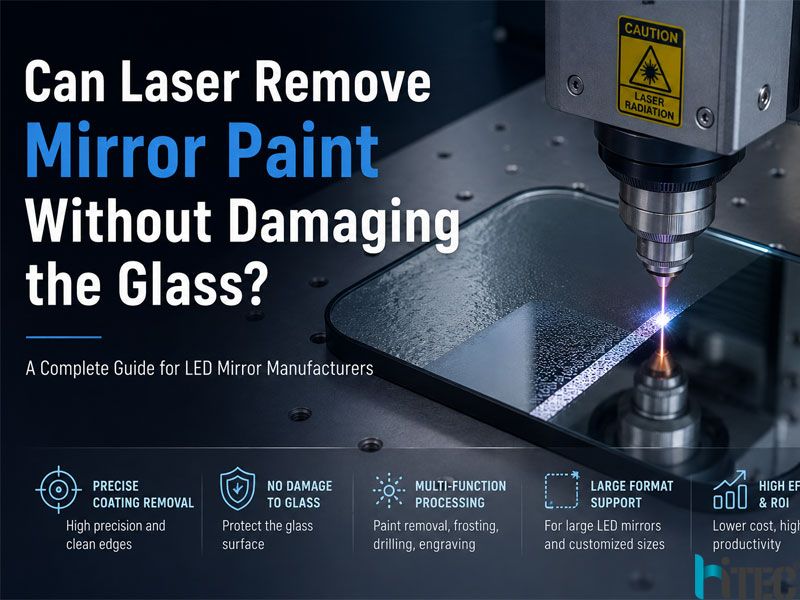
Can Laser Remove Mirror Paint Without Damaging the Glass?
2026-08-18 12:10:32
www.hiteccnc.com
Removing the backing paint or coating from a mirror sounds simple—until the glass is damaged.
For manufacturers of LED mirrors, smart mirrors, bathroom mirrors, decorative glass, and backlit mirrors, the real challenge is not simply removing the coating. The challenge is removing the coating precisely while keeping the glass surface clean, intact, and visually consistent.
This is one of the most important questions to consider when choosing a mirror laser marking or mirror laser paint removal machine.
The short answer is:
Yes, a properly configured laser can selectively remove mirror coatings without damaging the glass—but the result depends heavily on the laser source, power, optical system, processing parameters, mirror coating, and motion system.
That is why choosing a mirror laser machine should not be based on laser power alone.
Why Is Mirror Paint Removal Difficult?
A typical mirror is not simply a piece of glass.
Depending on the mirror construction, the back side may contain several layers, including reflective coating and protective paint or other protective layers.
The laser therefore needs to remove the target coating while minimizing thermal or mechanical impact on the glass substrate.
If the energy density is too high, the process may cause:
-- Glass surface damage
-- Micro-cracks
-- Excessive heat
-- Uneven coating removal
-- Burn marks
-- Rough edges
-- Unwanted damage outside the processing area
If the energy is too low, the coating may not be completely removed.
This creates a narrow processing window between insufficient removal and excessive energy input.
That is why a successful mirror laser solution requires more than simply installing a high-power fiber laser.
How Does Laser Mirror Paint Removal Work?
The basic principle is selective laser ablation.
The laser beam is focused onto the coating area. When the laser energy reaches the required threshold, the coating absorbs the laser energy and is removed from the designated area.
The glass underneath is treated differently because the laser parameters are selected to minimize interaction with the glass substrate.
This allows manufacturers to create transparent areas on a mirror for applications such as: LED lighting windows
Backlit logos
Touch-screen areas
Digital display windows
Decorative patterns
Transparent text
Functional sensor areas
Unlike conventional mechanical processing, there is no physical cutting tool contacting the mirror.
The result is a non-contact coating removal process.
The Most Important Factor: Laser Parameters
One of the biggest mistakes when buying a mirror laser machine is asking:
“Is 120W better than 200W?”
The better question is:
“Can the machine deliver the correct energy density and processing stability for my mirror?”
Laser power is only one part of the equation.
The final result is affected by:
1. Laser Power
Higher power can provide higher processing capability and productivity, but higher power does not automatically mean better quality.
For mirror processing, the machine needs to balance:
Power + pulse characteristics + scanning speed + frequency + focus + repetition + coating characteristics.
For this reason, different mirror materials may require different parameter sets.
2. Laser Source
Mirror processing is a highly reflective application.
The laser source and optical configuration therefore need to be selected specifically for the application.
A machine designed primarily for conventional metal marking should not automatically be considered suitable for mirror coating removal.
3. Scanning Speed
Processing speed determines how much energy is delivered to a particular area.
If the speed is too slow, excessive energy can accumulate.
If it is too fast, the coating may not be completely removed.
Therefore, production speed and processing quality must be optimized together.
4. Focus and Optical System
The laser must be accurately focused on the processing surface.
Poor optical alignment or unstable focusing can lead to: ♦ Uneven removal ♦ Different surface appearance ♦ Inconsistent line width ♦ Over-processing ♦ Under-processing For production environments, optical stability is therefore just as important as the nominal laser power.
Can Laser Remove Mirror Paint Without Scratching the Glass?
This is the question many mirror manufacturers should ask before purchasing a machine.
A properly developed process should remove the required coating area while keeping the glass visually clean.
However, it would be misleading to say that every laser can process every mirror without damage.
Different mirrors can have different:
· Reflective coatings
· Protective coatings
· Coating thicknesses
· Glass compositions
· Glass thicknesses
· Manufacturing processes
For example, silver mirrors, aluminum mirrors, and copper-free mirrors may behave differently during laser processing.
Recent industry specifications increasingly identify silver, aluminum, and copper-free mirrors separately, which reflects an important reality: mirror material should be tested before final machine configuration.
This is why sample testing is more valuable than simply comparing machine specifications.
What Should a Good Test Sample Show?
Before purchasing a mirror laser marking machine, ask the supplier to test your actual mirror.
Do not only ask for a photograph.
Ask for a complete processing test.
A useful test should evaluate:
Coating Removal
Is the coating completely removed?
There should be no obvious residual coating inside the intended transparent area.
Glass Condition
Look closely at the glass after processing.
Check for:
- Cracks
- Micro-cracks
- Burn marks
- Surface damage
- Unwanted discoloration
Edge Quality
The boundary between the removed and unprocessed areas should be clean and consistent.
This is particularly important for:
- Logos
- Letters
- Geometric patterns
- LED windows
- Fine decorative designs
- Uniformity
A large transparent or frosted area should have consistent appearance from one side to another.
Repeatability
One perfect sample is not enough.
The supplier should demonstrate that the same parameters can repeatedly produce the same result.
This is particularly important for commercial LED mirror production.
Traditional sandblasting is still used in many glass and mirror factories.
However, laser processing changes the production workflow significantly.
Factor
Laser Processing
Traditional Sandblasting
Contact with glass
Non-contact
Physical abrasive process
Dust
Very low
Significant
Abrasive material
No
Required
Masking
Often reduced or eliminated
Commonly required
Fine patterns
Excellent
More difficult
Digital design changes
Easy
More manual preparation
Small text
High precision
Limited
Automation
High
Depends on equipment
Repeatability
High with stable parameters
Operator dependent
Waste
Low
Abrasive waste
The biggest advantage is not simply speed
It is process control.
A digital design can be transferred directly to the laser system, allowing the manufacturer to change patterns, logos, text, and transparent areas without preparing a new physical stencil.
Current mirror laser systems on the market increasingly combine paint removal, frosting/sandblasting-style processing, and drilling into one machine, reflecting the demand for a more integrated production workflow.
Can One Mirror Laser Machine Also Do Frosting and Drilling?
Yes.
This is another major reason manufacturers are moving toward multifunctional mirror laser systems.
A properly configured machine can combine:
Mirror Paint Removal
Remove the reflective or protective coating to create transparent areas.
Laser Frosting / Sandblasting Effect
Create decorative frosted patterns, logos, borders, and textures.
Glass & Mirror Drilling
Create holes for:
LED components
Sensors
Mounting hardware
Electrical components
Bathroom accessories
Pattern Engraving
Create detailed decorative designs directly from digital files.
Some current commercial systems are marketed as 3-in-1 or 4-in-1 solutions combining these processes in a single platform.
This can be particularly valuable for LED mirror manufacturers because the same mirror may require several processing operations.
What About Large Mirrors?
For large mirrors, machine architecture becomes another critical consideration.
A small galvo marking system may provide excellent precision over its designed field, but large mirrors create a different production challenge.
For large-format mirror processing, the machine needs to consider:
For example, manufacturers are currently offering large-format mirror systems around 1300 × 2500 mm and larger customized formats for architectural and LED mirror applications.
For a factory producing full-size LED mirrors, the goal should be to process the required pattern as continuously and consistently as possible, rather than simply choosing the machine with the highest laser power.
What Laser Power Do You Need for Mirror Processing?
There is no universal answer.
The correct power depends on: ♦ Mirror coating ♦ Glass type ♦ Glass thickness ♦ Required processing effect ♦ Pattern density ♦ Processing area ♦ Production volume ♦ Required cycle time
120W and 200W systems are both appearing in current commercial mirror-processing configurations.
This demonstrates an important point:
The correct laser power should be selected according to the process—not the other way around.
If your primary application is small decorative patterns, buying excessive laser power may not provide the expected ROI.
If your factory processes large mirrors continuously, however, productivity may justify a higher-power configuration.
What Is the ROI of a Mirror Laser Machine?
ROI should not be calculated only from the machine purchase price.
A better calculation includes the total production cost.
Consider: Traditional process cost ⇒ Labor ⇒ abrasive materials ⇒ masking materials ⇒ chemical/cleaning costs ⇒ waste disposal ⇒ rework ⇒ maintenance ⇒ production time ⇒ versus: ⇒ Laser process cost ⇒ Electricity ⇒ laser source depreciation ⇒ maintenance ⇒ operator labor
The laser system may have a higher initial investment, but the production economics can become attractive when the machine is used regularly.
This is especially relevant for manufacturers producing customized LED mirrors, where every design may be different.
The ability to change a digital design without preparing new masks or abrasive templates can also reduce setup time.
The Most Important Question to Ask Your Laser Supplier
Instead of asking only: “How many watts is the laser?”
Ask these questions:
1. Can you process my actual mirror sample?
2. Can you show the coating-removal result under close inspection?
3. Can you demonstrate that the glass is not damaged?
4. What happens when the mirror supplier changes from silver to aluminum or copper-free mirror?
5. Can the machine process my maximum mirror size in one continuous workflow?
6. Can the same machine perform paint removal, frosting, and drilling?
7. What is the expected processing time for one complete mirror?
8. What laser source and optical configuration are being used?
9. How are stitching or positioning errors controlled on large mirrors?
10. Can you provide parameter support after installation?
These questions will tell you much more about the machine than a simple specification sheet.
Why Sample Testing Matters More Than a Specification Sheet
A mirror laser machine can look impressive on paper:
200W laser.
High-speed scanning.
Large working area.
High precision.
But none of these specifications guarantee the final mirror quality.
The real test is the finished product.
For this reason, HITEC Laser recommends evaluating a mirror laser system through actual customer samples whenever possible.
The test should use the customer's:
· Mirror type
· Mirror thickness
· Coating
· Design
· Required transparent area
· Frosting pattern
· Hole size
· Production requirements
The objective is not to prove that the laser can process a mirror.
The objective is to prove that it can produce the mirror you actually sell to your customers.
Final Thoughts
Laser mirror paint removal is not simply a matter of putting a powerful laser onto a mirror.
The real technology lies in controlling the relationship between:
Laser Source → Optical System → Energy Density → Scanning Speed → Material Coating → Motion Accuracy → Final Surface Quality
When these factors are correctly matched, laser processing can provide a clean, digital, repeatable alternative to conventional mirror sandblasting and coating-removal methods.
For LED mirror manufacturers, the biggest opportunity is not simply replacing one machine with another.
It is building a more flexible production process in which paint removal, frosting, decorative engraving, and drilling can be completed with one integrated laser platform.
If you are considering a mirror laser marking machine, the best starting point is not a quotation.
Send your mirror sample, mirror thickness, maximum panel size, and required design.
A proper processing test can tell you far more than a machine specification sheet.
About HITEC Laser
HITEC Laser develops industrial laser processing solutions for mirror, glass, metal, and other specialty materials.
For mirror applications, our solutions can be configured for laser paint/coating removal, frosting/sandblasting effects, decorative engraving, and glass or mirror drilling, with machine size and laser configuration selected according to the customer's actual material and production requirements.
Need to know whether your mirror can be processed without damaging the glass?
Send us your mirror type and application. We can evaluate the processing requirements and recommend a suitable laser configuration.