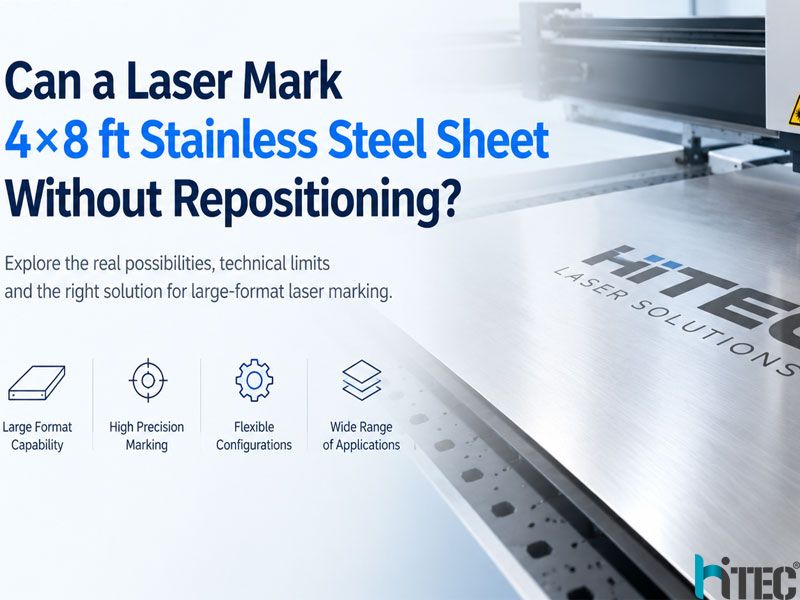
Can a Laser Mark 4×8 ft Stainless Steel Sheet Without Repositioning?
2026-09-10 11:34:06
www.hiteccnc.com
Why Is 4×8 ft Laser Marking Difficult?
Most fiber laser marking machines use a galvo scanning head.
The galvo mirrors move the laser beam rapidly across the work area, while a focusing lens determines the available optical marking field.
For example, a conventional setup may provide a marking area such as:
110 × 110 mm
175 × 175 mm
300 × 300 mm
600 × 600 mm
These fields are highly effective for small and medium-sized components.
But a 1220 × 2440 mm stainless steel sheet is much larger.
This creates a fundamental limitation: The galvo optical field cannot simply be enlarged indefinitely by using a larger lens.
As the required field increases, factors such as spot size, energy density, working distance and marking quality also become important.
Can a Conventional Galvo Mark a 4×8 ft Sheet?
Not as one single optical field.
A conventional galvo laser can certainly process a large stainless steel sheet, but if the required design is larger than the lens field, the workpiece or marking process must be divided into sections.
For example, if a design extends across an area much larger than the available galvo field, the operator may need to:
1. Mark one section.
2. Reposition the workpiece or move the system.
3. Align the next section.
4. Continue processing.
5. Maintain alignment between sections.
This approach can work, but it introduces additional setup requirements.
For decorative patterns, large logos, large-format text or precision graphics, alignment between sections becomes particularly important.
What Is a Large Format Laser Marking System?
A large-format laser marking system combines the high-speed scanning capability of a galvo head with controlled mechanical movement.
Instead of relying only on the optical scanning field, the laser head or worktable moves across the larger workpiece.
This allows the machine to process areas substantially larger than a conventional single galvo field.
The basic concept is:
Galvo scanning
→ Fast laser movement within the optical field
Mechanical movement
→ Extends the usable processing area
Combined system
→ Large-format laser processing
This architecture is particularly useful for large metal plates, elevator panels, industrial nameplates and oversized stainless steel components.
Does "Without Repositioning" Mean No Stitching?
This is where the terminology becomes important.
A large-format laser system should not be described as an unlimited two-axis continuous marking system.
The optical field of the galvo lens remains finite.
When a design extends beyond that field, the system may need controlled sectional processing or stitching depending on the application.
However, mechanical movement can greatly reduce the need for manual repositioning of the workpiece.
This is an important distinction.
Manual Repositioning
The operator physically moves or realigns the workpiece between sections.
Controlled Mechanical Movement
The machine automatically moves the laser system according to the programmed processing path.
The second approach can provide a more controlled and repeatable process for large-format applications.
Can HITEC Process a 4×8 ft Stainless Steel Sheet?
HITEC offers large-format fiber laser configurations including a 1300 × 2500 mm working area, approximately:
51 × 98 inches
This is slightly larger than a standard 4 × 8 ft sheet (48 × 96 inches).
That makes this configuration suitable for applications involving large stainless steel sheets and oversized metal panels.
However, the exact processing method depends on what you want to mark.
For example:
Case 1 — One Large Logo
If the logo extends across a large portion of the sheet, the system configuration and marking strategy need to be evaluated according to the optical field and required accuracy.
Case 2 — Multiple Metal Logos
Multiple logos can be arranged across the larger working area.
This is one of the practical advantages of a large-format system because several components can potentially be processed in one setup.
Case 3 — Large Decorative Pattern
Large decorative graphics require careful consideration of the optical field, movement accuracy and stitching strategy.
Case 4 — Deep Engraving
If the objective is not simply surface marking but deep engraving, laser power becomes another important factor.
Typical Direction
Laser Power
Typical Application
50–100W
Standard marking, logos, serial numbers and identification
200W
Deep engraving and higher material removal
300W
High-volume deep engraving
500W
Heavy-duty engraving and demanding material-removal applications
These are general guidelines rather than fixed specifications. Actual results depend on the material and processing parameters.
Why 200W and Higher Power Can Matter
When marking stainless steel, laser power affects more than simply marking speed.
For deep engraving, the objective is to remove material from the surface.
A higher-power laser can provide greater material-removal capability, potentially reducing the number of passes required for a given application.
For example:
Surface marking
→ Low material removal
→ Lower power may be sufficient
Deep engraving
→ Significant material removal
→ Higher power becomes more valuable
For this reason, a customer looking for a 4×8 ft stainless steel deep engraving solution should not select a machine based solely on the working area.
The complete configuration matters.
Large Format Does Not Mean "Unlimited"
There is a common misunderstanding in the laser industry:
"If the machine has a 2500 mm working area, it can continuously mark 2500 mm in both X and Y with zero stitching."
This is not technically accurate.
The mechanical working area and the optical marking field are two different things.
The mechanical system determines how far the laser head or worktable can move.
The lens determines the optical field available to the galvo scanner.
Therefore, a professional large-format laser system should be evaluated by looking at both:
Mechanical travel
and
Optical field
rather than treating the working-area specification as an unlimited optical field.
What About a 4×8 ft Sheet That Must Be Marked as One Continuous Design?
This is where the application needs to be evaluated carefully.
If the customer requires a single large graphic covering almost the entire 4×8 ft sheet, the machine may use a combination of:
- Galvo scanning
- Mechanical movement
- Controlled positioning
- Sectional processing
- Stitching or overlap strategies where required
The appropriate strategy depends on the required visual continuity and dimensional accuracy.
For some applications, tiny transitions may be visually irrelevant.
For others—especially precision graphics or decorative patterns—stitching accuracy becomes a critical specification.
A responsible laser manufacturer should therefore test the actual design on the actual material before promising a particular result.
Large Format Laser vs. Conventional Galvo
Feature
Conventional Galvo Laser
Large Format Laser System
Optical marking field
Limited by lens
Extended through controlled mechanical movement
Large metal plates
Limited by optical field
Designed for large workpieces
4×8 ft sheet
Requires sectional processing/repositioning
Can accommodate large sheets with an appropriate configuration
Oversized layouts
May require repositioning
Better suited for large-area processing
Multiple plates
Limited by field size
Multiple parts can be arranged in one setup
Large nameplates
Requires careful positioning
Designed for large-format processing
Deep engraving
Available
Available with higher-power configurations
Production flexibility
Best for small/medium parts
Better suited for large and oversized components
Mechanical movement
Usually limited or unnecessary
Integral to extending the processing area
Best application
Small and medium components
Large plates, panels and oversized components
What Should You Check Before Buying?
If you are considering a laser for 4×8 ft stainless steel sheets, do not look only at the advertised working area.
Ask the manufacturer these questions:
1. What is the actual optical field?
A 1300 × 2500 mm machine does not necessarily have a 1300 × 2500 mm optical field.
2. How does the system extend the marking area?
Ask whether it uses:
·
Mechanical movement
·
·
Moving table
·
·
Moving galvo head
·
·
Sectional processing
·
·
Stitching
·
3. What happens when the design exceeds the lens field?
This is one of the most important technical questions.
4. What is the positioning accuracy?
Large-format processing requires the mechanical movement and optical system to work together accurately.
5. Can you test my actual file?
This is much more useful than testing a simple square or serial number.
Provide the manufacturer with:
·
Your actual stainless steel sheet
·
·
Your actual graphic
·
·
Required dimensions
·
·
Required depth
·
·
Required contrast
·
·
Required cycle time
·
Then evaluate the actual result.
What Applications Are Suitable for a 4×8 ft Large Format Laser?
Large-format fiber laser systems are particularly useful for applications such as:
Elevator Panels
Large stainless steel elevator panels can require decorative patterns, logos, text and other graphics across a substantial surface area.
Large Metal Nameplates
Industrial identification plates and equipment panels can be arranged across a large working area.
Stainless Steel Sheets
Large-format marking can be used for decorative graphics, logos, identification and surface treatment.
Industrial Logos
Large logos can be marked or engraved directly onto metal panels.
Multiple Metal Plates
Several smaller components can be positioned across one large working area, potentially reducing manual loading and alignment.
Deep Engraving
Higher-power configurations can be used when the application requires significant material removal.
The Right Question Is Not "Can It Mark 4×8 ft?"
The better question is:
How does the laser system process my 4×8 ft sheet, and what happens when the design exceeds the optical field?
This distinction separates a genuine large-format laser solution from a machine that simply has a large table.
For large stainless steel applications, you should evaluate:
**Working area
·
Optical field
·
·
Mechanical movement
·
·
Positioning accuracy
·
·
Stitching strategy
·
·
Laser power
·
·
Material
·
·
Required depth
·
·
Actual marking result**