How to Choose: Glass Drilling, Picosecond Laser Cutting & CNC Cutting Guide
2026-04-29 11:00:10
www.hiteccnc.com
A practical breakdown of three mainstream glass fabrication technologies — their strengths, limitations, and ideal applications — to help you make an informed decision.
Precision glass and mirror processing is a critical step across industries — from architectural glazing and furniture manufacturing to consumer electronics and optical instruments. With multiple technologies available today — mechanical drilling, picosecond laser cutting, and CNC scoring & breaking — it can be difficult to know which method best suits your product requirements. This guide compares all three across technology principles, application scenarios, and key trade-offs, so you can choose with confidence.
Mechanical Drilling: The Reliable, Proven Standard
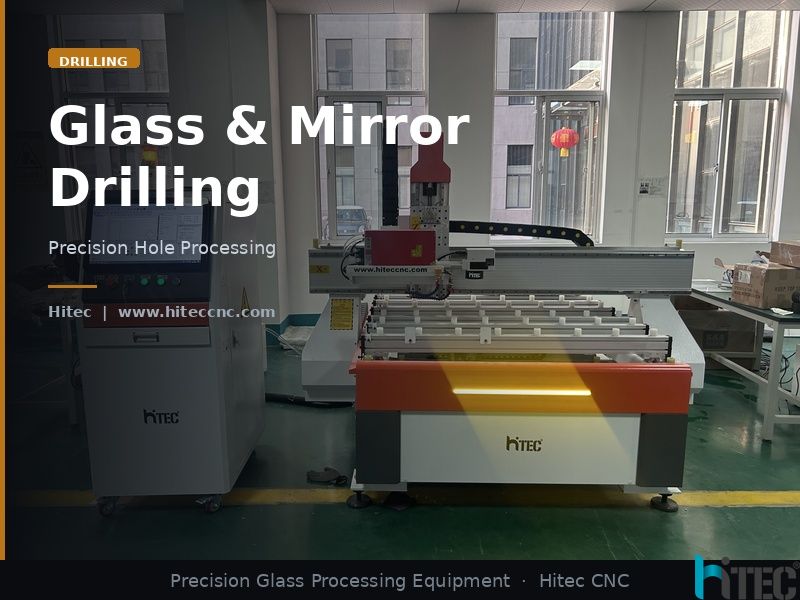
Mechanical drilling uses diamond-tipped drill bits combined with a water-cooling system to bore circular holes through glass or mirror substrates. It remains the go-to process for applications where hardware fittings need to be mounted — think cabinet glass doors, bathroom mirrors, and furniture panels.
Compatible Materials
Float glass, annealed tempered glass, mirror glass, laminated glass
Accuracy
±0.1–0.3 mm — sufficient for standard hardware hole sizes
Low equipment cost, easy maintenance, minimal operator training required
High throughput for standard circular holes in bulk production
Wide hole-diameter range — typically 4 mm to 100 mm
Limitation: restricted to circular holes; non-round profiles require a different process
Limitation: tempered glass must be drilled before the tempering process
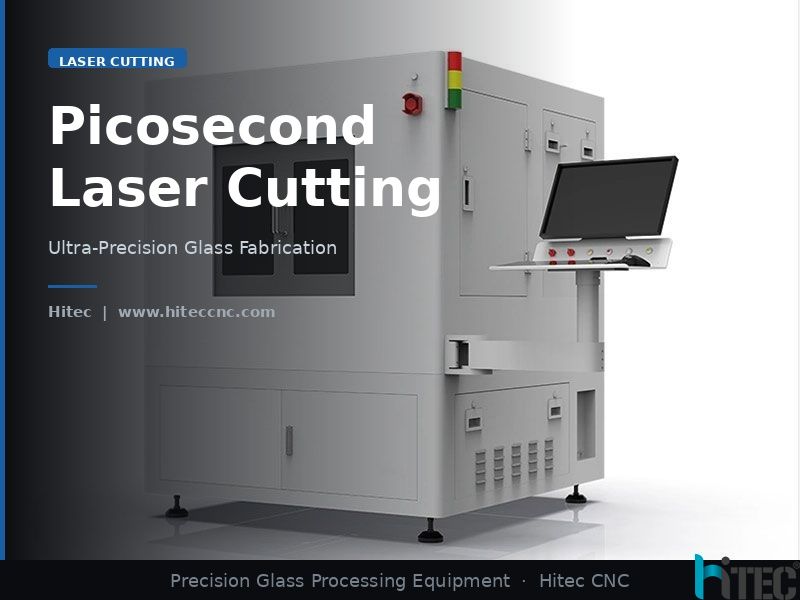
Picosecond Laser Cutting System — Enclosed Cabinet (Hitec)
Picosecond lasers emit pulses at 10⁻¹² second intervals, depositing energy so rapidly that material is ablated with virtually no heat transfer to surrounding zones — a process known as "cold ablation." The result is near-zero chipping, no micro-cracks, and an exceptionally clean edge. This technology is the preferred choice for OLED cover glass, smartphone back panels, precision optical components, and medical device glass.
Compatible Materials
Ultra-thin glass (0.1–3 mm), sapphire, quartz, specialty optical glass
Accuracy
±0.01–0.05 mm with high edge surface quality
Cuts any freeform contour — internal holes, slots, complex curves, notches
Non-contact process; edges typically require no secondary grinding
Ideal for high-value consumer electronics, medical devices, and semiconductor applications
Limitation: higher capital investment — best justified by high-margin products
Limitation: throughput drops significantly on glass thicker than 19 mm
CNC Cutting: High-Efficiency Solution for Large-Format Glass
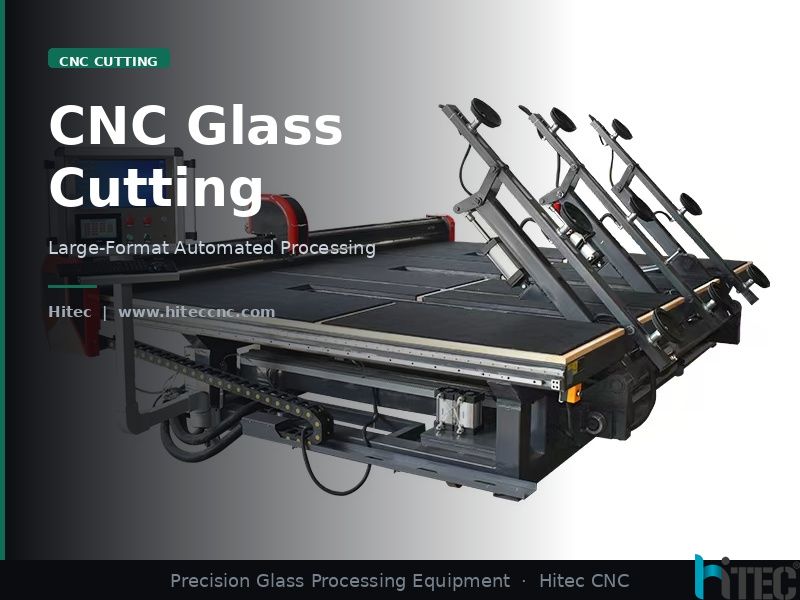
CNC glass cutting machines use a diamond scoring wheel guided by a CNC motion system to scribe precise paths across the glass surface, followed by a controlled break. The integrated tilting loading racks and large working table shown here are designed to handle full-size architectural sheets with minimal manual handling — making this the backbone of glazing, furniture panel, and photovoltaic glass production lines.
Compatible Materials
Float glass, Low-E coated glass, laminated glass blanks — 3 to 19 mm thick
Accuracy
±0.2–0.5 mm, optimized for straight lines and gentle arcs
Large working area (up to 3660 × 2440 mm) for full-sheet processing
Integrates with ERP/MES systems for nesting optimization and waste reduction
Lowest cost-per-cut for high-volume straight-line production
Limitation: precision on complex curved profiles is limited; tight radii may need edge grinding
Limitation: manual breaking step remains unless a fully automated break-out table is added
Quick Answer
If you need simple round holes → choose Glass Drilling Machine
If you need ultra precision and complex shapes → choose Picosecond Laser
If you need large sheets and high efficiency → choose CNC Glass Cutting
Side-by-Side Comparison & Buying Guidance
Dimension
Mechanical Drilling
Picosecond Laser
CNC Cutting
Process type
Circular holes only
Any freeform profile
Straight lines / simple arcs
Accuracy
±0.1–0.3 mm
±0.01–0.05 mm
±0.2–0.5 mm
Glass thickness
3–19 mm
0.1–19 mm
3–19 mm
Equipment cost
Low
High
Medium
Typical applications
Bathroom mirrors, furniture glass
Smartphone covers, optical lenses
Architectural glazing, furniture panels
Post-processing
Edge grinding / chamfering
FAQ
Q1: Can picosecond laser cut thick glass?
A: Typically up to 19mm efficiently…
Q2: Is CNC cutting suitable for curved shapes?
A: Only simple arcs, not complex contours…