
- Home
- About HITEC
- Products
- Samples
- Service and Support
- News
- Contact HITEC

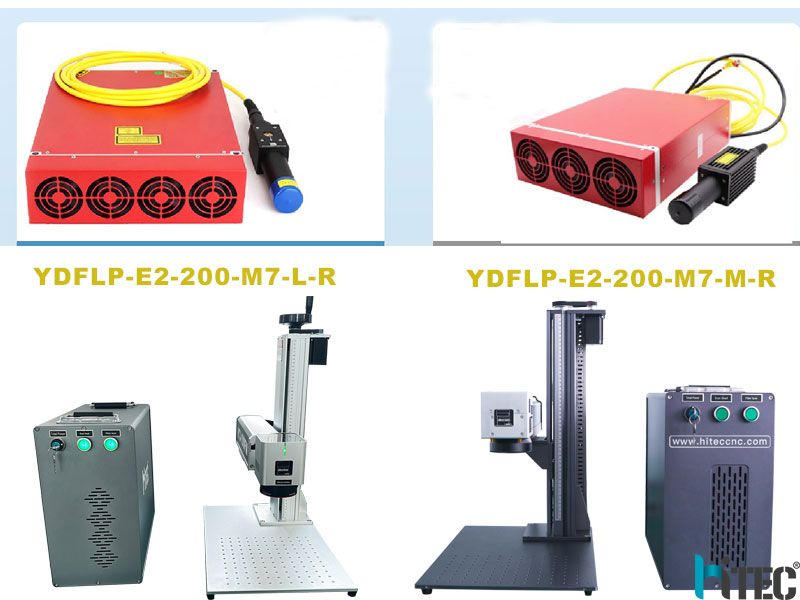
When selecting a pulsed fiber laser source for industrial marking, engraving, or material processing, the choice of model can have a significant impact on performance and final results. Two closely related options in the JPT M7 MOPA family are the YDFLP-E2-200-M7-M-R and YDFLP-E2-200-M7-L-R. While they share many core specifications, the differences in fiber mode type and related beam quality are key to deciding which is right for your application.
So the first import things is you need to clear which kind of job you want to process use the laser machine.
1. Core Similarities
Both models are part of the M7 series of high-power Master Oscillator Power Amplifier (MOPA) pulsed fiber lasers, offering:
Nominal average output power: ~200 W
Adjustable repetition rate: ~1 – 4000 kHz
Pulse width range: ~2 – 500 ns
Air-cooled design
1064 nm wavelength
Pulse shaping control and high peak power — ideal for high-speed marking and versatile processing beyond conventional Q-switched lasers.
These shared features make both models capable of fast, precise marking on metals, plastics, and other industrial materials.
2. Key Difference: Fiber Mode Type
The central distinction between the two models lies in the optical fiber attributes, which affects beam quality and how tightly the laser can focus:
M variant (…-M-R) — Near-single-mode fiber:
Beam quality factor M² < 1.6
Typically a longer armored cable (~5 m)
Provides a tighter, more focused spot size for finer precision.
L variant (…-L-R) — Low-mode fiber:
Beam quality factor M² < 1.8
Typically a shorter cable (~3 m)
Slightly larger effective spot and marginally reduced focus sharpness.