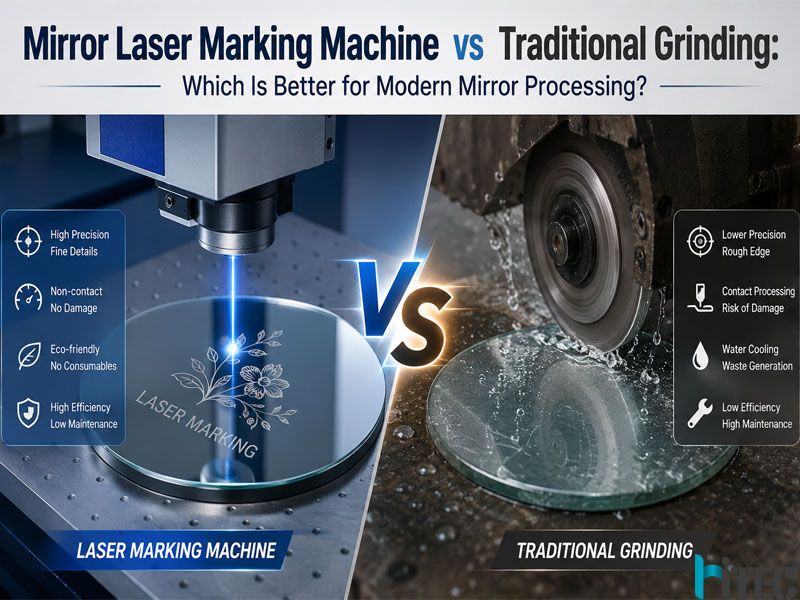
Mirror Laser Marking Machine vs Traditional Grinding: Which Is Better for Modern Mirror Processing?
2026-05-07 17:15:01
www.hiteccnc.com
Mirror Laser Marking Machine vs Traditional Grinding: Which Is Better for Modern Mirror Processing?
Introduction
With the rapid growth of smart mirrors, LED bathroom mirrors, decorative mirrors, and customized glass products, manufacturers are looking for more efficient and precise processing technologies.
Traditional mirror grinding and sandblasting methods have been widely used for years, but they often come with limitations such as dust pollution, inconsistent results, high labor costs, and slower production speeds.
Today, more manufacturers are switching to laser processing technology.
A modern mirror laser marking and cutting machine can complete mirror engraving, sandblasting effects, logo marking, edge processing, and pattern creation with higher precision and lower maintenance requirements.
In this article, we compare:
Mirror Laser Marking Machine vs Traditional Grinding & Sandblasting from the perspective of:
Production Efficiency
Processing Quality
Cost & Maintenance
ROI (Return on Investment)
1. Processing Efficiency
Traditional Grinding
Traditional grinding usually requires:
Manual positioning
Abrasive wheel processing
Repeated polishing
Dust cleaning
Additional finishing steps
For complex mirror designs or customized patterns, production efficiency becomes even lower.
In many factories, grinding also depends heavily on operator experience.
Mirror Laser Marking Machine
A mirror laser marking machine uses non-contact laser technology to process mirror surfaces directly.
Advantages include:
High-speed scanning
Automatic positioning
No tool wear
Faster pattern switching
Continuous production capability
Complex graphics, logos, and customized designs can be completed within seconds.
For large-scale smart mirror production, laser processing significantly improves production efficiency.
Efficiency Comparison
Item
Traditional Grinding
Mirror Laser Machine
Processing Speed
Slow
High
Automation Level
Low
High
Pattern Switching
Manual
Instant
Labor Dependence
High
Low
Production Consistency
Medium
Excellent
2. Processing Effect & Precision
Traditional Grinding Problems
Traditional grinding often causes:
Uneven sandblasting effects
Surface scratches
Edge damage
Inconsistent depth
Dust contamination
For high-end LED smart mirrors, these defects directly affect product quality.
Laser Processing Advantages
Laser mirror processing provides:
Clean and precise engraving
Smooth edges
Uniform frosted effects
High-detail graphics
Better consistency
Laser technology is especially suitable for:
Smart mirrors
Decorative mirrors
Hotel mirrors
LED mirrors
Custom logo mirrors
Glass display panels
The final visual effect is cleaner and more modern compared with traditional grinding.
3. Cost & Maintenance
Traditional Grinding Costs
Although traditional grinding equipment may appear cheaper initially, long-term operating costs are often high.
Common expenses include:
Abrasive wheel replacement
Dust treatment systems
Labor costs
Frequent maintenance
Tool wear
Production waste
In addition, environmental requirements are becoming stricter in many countries.
Dust and waste generated during grinding may increase factory operating pressure.
Mirror Laser Machine Costs
Laser machines have:
Lower consumable costs
Minimal maintenance
No abrasive tools
Lower labor requirements
Cleaner production environment
Modern fiber and UV laser systems also offer long service life and stable performance.
Over time, operating costs become significantly lower.
Item
Traditional Grinding
Laser Processing
Consumables
High
Low
Tool Wear
Serious
None
Maintenance Frequency
High
Low
Dust Pollution
Heavy
Minimal
Labor Cost
High
Lower
Production Waste
More
Less
4. ROI (Return on Investment)
For many mirror manufacturers, ROI is the most important factor.
Although laser equipment usually requires a higher initial investment, the return becomes clear after long-term production.
Why Laser ROI Is Better
1. Higher Production Speed
More products can be completed in less time.
2. Reduced Labor Cost
Fewer operators are required.
3. Better Product Quality
Higher-end products bring higher profit margins.
4. Lower Maintenance Cost
No grinding wheel replacement or heavy maintenance.
5. More Flexible Production
Laser machines can quickly switch between designs and customized orders.
This is especially important for modern customized mirror markets.
Which Industries Are Switching to Laser Processing?
More companies in the following industries are adopting mirror laser marking technology:
LED Smart Mirror Manufacturing
Bathroom Mirror Production
Decorative Glass Processing
Hotel & Commercial Mirrors
Home Decoration Industry
Customized Mirror Branding
As consumer demand for premium mirror products increases, laser processing is becoming the preferred solution.
Conclusion
Traditional grinding still works for some basic applications, but modern mirror manufacturing increasingly requires:
Higher precision
Better consistency
Faster production
Cleaner processing
Lower operating costs
A mirror laser marking and cutting machine provides clear advantages in efficiency, quality, automation, and long-term ROI.
For smart mirror manufacturers and high-end glass processing factories, laser technology is becoming the future of mirror processing.
About HITEC LASER
HITEC LASER specializes in industrial laser solutions for mirror and glass processing industries, including:
Mirror Laser Sandblasting
Smart Mirror Laser Processing
Glass Laser Marking
Large Format Laser Systems
UV Laser Solutions
Customized Automation Equipment